

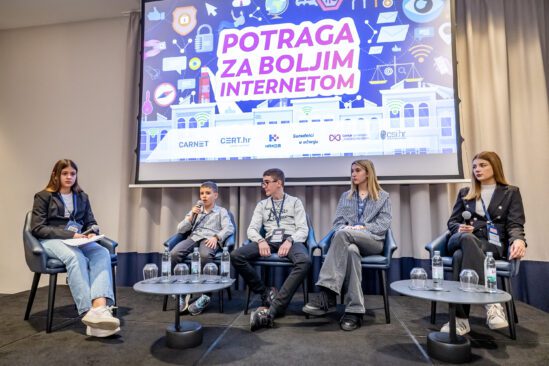
The conference “Searching for a Better Internet 2025” brought together over 150 experts, teachers, and elementary and secondary school students to mark the international Safer Internet Day. The conference was organized by the association Learning Partners, Safer Internet Centre, HAKOM and CARNET's National CERT She emphasized the importance of education and raising awareness among children, and especially parents and caregivers, about the dangers on the internet.
A special emphasis of this year's conference was placed on a round table discussion with primary and secondary school students, where the advantages and dangers of the internet were discussed. The students agreed on one thing – although the internet offers numerous opportunities for learning and entertainment, it is important that we know how to use it safely.
Students warned of threats like identity theft, cyberbullying, catfishing (when people impersonate others online to deceive others) and the spread of false information. They particularly emphasized the importance of a critical approach to information and verifying sources, because, as they say, we cannot believe everything we read on the internet.
The discussion also touched upon how the internet reflects our personality and behavior, emphasizing the importance of communicating with others as we wish them to communicate with us. Sharing positive comments and offering support can contribute to creating a safer and more pleasant online space, the students agreed.
They also pointed out how they can influence the content they follow on social media. By choosing quality and positive posts, they can shape social media algorithms and reduce the presence of negative content in their feed.
In the end, everyone agreed that adults, especially parents, play a crucial role in educating children about online safety. They should set an example, actively monitor their children's online activities, provide support, and have open conversations with them. Online safety is not just the responsibility of children, but also of adults, who need to work together to create a safer online environment for everyone.
“Our common goal is to ensure a safe and quality online environment for children. To achieve this, we must work together and build upon the activities of other stakeholders. Therefore, it is good that teachers, parents, associations, educational institutions, and HAKOM, as the electronic communications market regulator, are cooperating in Croatia,” he stated. Miran Gosta, Director of HAKOM, adding that HAKOM is the coordinator for digital services and the implementation of the Digital Services Act in Croatia and collaborates with social networks and platforms when illegal content needs to be removed.
Nataša Glavor, Assistant Director of CARNET for the National CERT She pointed out that young people are one of the most vulnerable groups online, precisely because of their playfulness and unpreparedness for the threats that technology can bring. “Play can easily turn into cyberbullying, while exposure to age-inappropriate content can cause numerous problems for children. It is very important to be informed about current cyber threats so that they can be recognized in time and prevent us from becoming victims,” Glavor concluded.
Darko Rakić, President of the Associates in Learning Association He drew attention to disinformation as one of the main dangers on the internet. “Children today spend too much time on social media and the internet and receive a lot of information that they accept without verification. We need to teach them to think critically, not only to assess the truthfulness of information but also about new technologies such as artificial intelligence, deep fakes, and the like.”.
“The most dangerous part of the internet is child sexual abuse through new technologies. Challenges on various social networks that can endanger children's health and lives are also becoming increasingly dangerous,” he emphasized. Tomislav Ramljak, Director of the Safer Internet Centre, emphasizing that “Safer Internet Day is important because, regardless of technology, the trust relationship between children and parents is crucial in protecting children online.”.
“Let's listen to children, build strong relationships with them, and discover the digital world and grow together, combining their knowledge of new technologies with our experience and wisdom in protecting their safety,” she concluded. Helenca Pirnat Dragičević, Children's Ombudsman.
The conference discussed the importance of internet safety, with an emphasis on protecting users of electronic communication services and promoting responsible behavior in the digital space. Challenges in digital education, recognizing fake news, and online privacy protection were analyzed, along with guidelines for teaching children responsible internet use.
The forms of cyberbullying, its consequences, and the legal frameworks that regulate this issue have been considered, along with proposed preventive and intervention measures for parents and teachers. Current trends in cybercrime, including online abuse, fraud, and identity theft, as well as preventive measures for protecting children and youth, have also been analyzed.
Experts and children discussed possibilities for creating a safer and more inclusive digital environment and societal adaptations to rapid technological changes to make the internet a safe space for communication and education. An overview of key activities and initiatives aimed at protecting children from digital threats and ways to recognize and address risky situations online was presented. It was also emphasized that teachers need to keep pace with the development of new technologies so they can impart knowledge to children necessary for navigating and using the internet more safely.