

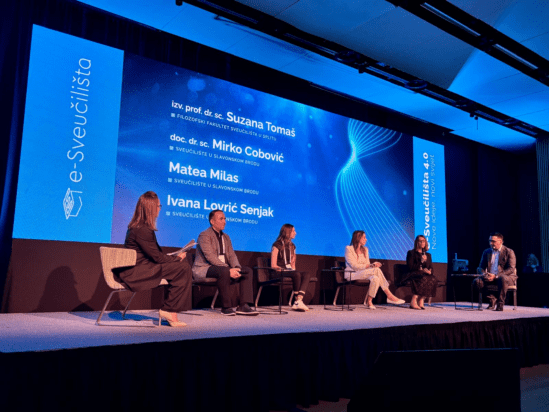
The three-day conference has ended THECUC 2025, dedicated to innovation and digital transformation in higher education in Croatia. This year's edition's theme, „e-Universities 4.0 – New Ideas, New World“, it has also spurred discussions on digital technologies, multimedia in teaching, and European interoperability of university systems.
Particular attention on the last day of the conference was drawn to PechaKucha session, in which a pilot study and related action research are presented “”Application of multimedia in higher education". These activities were carried out in 21 institutions with over 70 participants across Croatia, aiming to strengthen infrastructure, equip institutions with multimedia studios, build a community of practitioners, and research how digital technologies can improve learning, teaching, and collaboration processes.
The Pecha Kucha session allowed participants to gain insight into the results of the action research through short, dynamic presentations, with a special focus on the role of students who, alongside university staff, presented their experiences.
One of the main outcomes of the action research is the spirit of collaboration that has emerged between professors, students, librarians, IT, and administrative staff in integrating digital technologies into education. Furthermore, the research has resulted in recommendations for the successful continuation of the digital transformation of higher education institutions in Croatia so as to maximize the utilization of available equipment, training, and digital technologies.
Panel „European Interoperability Framework for Higher Education – A Common Path Towards 2030“, he gathered experts from Agencies for Science and Higher Education, CARNET, University Computing Centre SUniversity of Zagreb and the University of Rijeka who discussed how standards, processes, and pilot projects can enable data, services, and credentials to follow students and institutions across borders as easily as physical borders are crossed today.
All panelists unanimously confirmed that the regulatory framework, people's readiness, infrastructure, clear commitments, and the launch of pilot applications form the foundation for progress. Student mobility and system interoperability are not just technical issues; they represent a strategic leap for Croatian higher education into the European knowledge space.
Conference participants had the opportunity to attend numerous workshops, testing new digital tools and learning about examples of multimedia application in teaching, digital competence development, and student motivation for creating multimedia content.