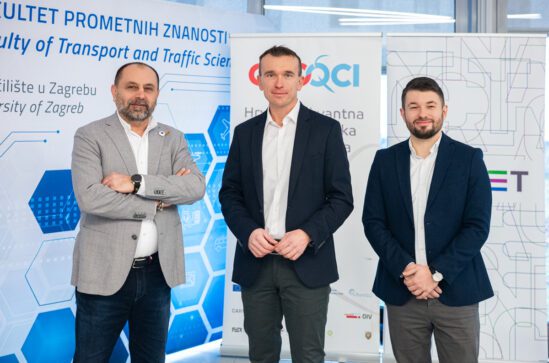
The Faculty of Transport and Traffic Sciences of the University of Zagreb presented the results of research work within the national project CroQCI, which aims to build a Croatian quantum communication network resistant to future quantum computing threats. Fa Expertskulteta has developed a unique simulation platform that enables precise planning and testing of the functionality of quantum networks – a technology that will, in the near future, protect communication in financial institutions, healthcare systems, and other segments of critical infrastructure. Quantum Key Distribution (QKD), which uses the laws of quantum physics to generate and exchange cryptographic keys, is one of the main elements of the project, and FPZ is among the most important stakeholders working on its implementation in Croatia.
Future quantum computers will be able to break much of the classical cryptography that protects sensitive data today, raising questions about the long-term security of communication. To address this challenge, QKD does not transmit user messages, but rather ensures that the keys protecting those messages are generated in a tap-proof manner. In practice, any attempt to tamper with the quantum channel leaves a recognizable trace, allowing the system to automatically defend itself and change communication parameters.
“A particularly important segment of the FPZ's work is the development of a simulation environment in which various designs of future quantum networks are tested, their scalability is assessed, and iterative architecture testing is carried out. Such simulations are extremely important for optimal planning and implementation of QKD networks because they enable cost reduction, increased functionality, and early identification of challenges.”, he emphasized Prof. Dr. Sc. Dragan Peraković, Work Package Leader for Terrestrial Optical Infrastructure in the project CroQCI You are the head of the Institute for Information and Communication Traffic at the Faculty of Transport and Traffic Sciences.
FPZ experts conducted a detailed analysis of available quantum communication simulation platforms and selected tools that best suit the needs of simulating different layers of the QKD network architecture. During the analysis, it was determined that no existing solution allows for the simulation of the entire QKD architecture, and therefore, at FPZ, a Docker – A foundational platform that unifies multiple existing simulation tools into one coherent solution.
“ At the CroQCI project, we are aware that absolute security does not exist. Although the laws of quantum physics guarantee the theoretical absolute security of a communication channel, in the actual implementation of a quantum communication network, it is necessary to integrate a series of elements, devices, and systems that communicate with each other. It is precisely in this complex ecosystem that potential vulnerabilities arise, which we must identify and eliminate.
At the Faculty of Transport and Communications Sciences, through the Laboratory for Security and Forensic Analysis of Information Communication Systems, we are systematically approaching the implementation of a quantum network – we identify possible vulnerabilities, conduct security testing, and define procedures and processes for future security validation of quantum communication networks. In this way, we strive to make Croatian quantum communication infrastructure not only technologically advanced, but also secure, reliable, and resilient to future threats.”, pointed out Dr. Ivan Cvitić, Head of the Laboratory for Information and Communication System Security and Forensic Analysis at the Faculty of Transport Sciences.
The Faculty of Transport and Traffic Sciences is working on a systematic analysis of cyber threats specific to QKD networks, as absolute security does not exist and the complexity of the system increases the potential vulnerability surface. Although the laws of quantum physics provide a theoretically high level of protection, a QKD system in reality consists of a large number of interconnected hardware and software components that need continuous testing. Therefore, FPZ develops models for security verification and uses tools that enable the simulation of various types of cyber attacks, thereby verifying the system's resilience and creating prerequisites for its long-term stability.
The Faculty of Transport and Traffic Sciences is participating in the project through three work packages, in collaboration with CARNET and other partners, including defining the architecture of the quantum communication network, selecting locations for QCI nodes, and shaping their intercommunication methods. In addition to developing the network architecture, FPZ participated in shaping the proposal for the national quantum communication network and in modeling its connection with the networks of other European Union member states.
Within work package WP3 – Terrestrial infrastructure, FPZ, as coordinator, together with Odašiljači i veze d.o.o., successfully adapted collocations storage for receiving equipment and implemented a dark fiber optic network in the City of Zagreb area. This infrastructure is necessary for connecting points in CroQCI the network and the transmission of quantum-entangled photons that form the basis of quantum key distribution. The optical network is constantly monitored and upgraded, in accordance with system needs and identified technological challenges, thereby creating conditions for the future expansion of quantum communications at the national and international level.