

As part of the action research "Multimedia in Higher Education," we visited some of the most active participants in the action research and e-University project: Assistant Professor Mirko Cobović, Head of the University Undergraduate Study of Economics; Miroslav Mazurek, Head of the IT and Computer Networks Office; and Assistant Professor Zrinka Šimunović from the Department of Teacher and Preschool Teacher Education of the Department of Social and Human Sciences. Universities in Slavonski Brod.
The University of Slavonski Brod is a relatively young higher education institution, established in 2020 through the merger of several higher education components that were previously part of the Josip Juraj Strossmayer University of Osijek – the Faculty of Mechanical Engineering in Slavonski Brod, off-campus study programs of the Faculty of Education, the Student Center, and the Polytechnic of Slavonski Brod. The University currently operates through several constituent units (Faculty of Mechanical Engineering in Slavonski Brod, Department of Social Sciences and Humanities, Technical Department, Biotechnical Department tea Student Center in Slavonski Brodwith a rich study portfolio at the university and professional level, and with a pronounced role in regional development.
With experience from working in Slavonski Brod and the current collaboration with the action research team within the project, we knew that the number of students and the structure of the study programs allowed for intensive work in smaller groups, a very direct and collegial relationship between teachers and students, and rapid implementation of innovations and a stronger impact on the local community. With these positive expectations, we proceeded to this meeting, which did not disappoint us.
On the way from Zagreb to Slavonski Brod, we are listening to a student podcast. UNICAST, created with multimedia equipment assigned through the e-University pilot project, an episode in which students hosted the rector, bringing him closer to their audience in a very spontaneous and simple way, and setting a cheerful and exuberant tone for future episodes. Upon arriving at the University, we were greeted by the rector, Professor Ivan Samardžić, who, in his review of the assigned equipment and the e-University project, shared his views on contemporary university teaching. Using the film metaphor of “The Last Samurai,” the professor painted a picture of the transformation of the educational system in the context of technological changes, where it remains important to preserve the fundamental determinants of education – discipline and positive practices of traditional teaching.
Teacher's Perspective: Infrastructure, Equipment, and the Need for a Sustainable Support Model
After speaking with the Rector, a brief discussion with colleagues, participants of the action research, followed. Miroslav Mazurek, Head of the Office for Informatics and Computer Networks, spoke from an infrastructural perspective. He emphasized that work on the network infrastructure is in its final stages and that the new network is already active and functional in some locations. The quality of connectivity, system stability, and technical support—both from CARNET and the contractors—were recognized as essential components without which all further steps, especially those related to action research (multimedia, hybrid teaching, recording), would be meaningless. In practical terms, the plan is to equip some spaces with fixed multimedia equipment and use mobile solutions for other classrooms, which, according to Mr. Mazurek, will achieve flexibility while rationally using resources. Assistant Professor Mirko Cobović, Ph.D., provided a broader institutional perspective and praised the completeness of the project: from infrastructure, through equipment, to training and networking. As already demonstrated through the pilot phase of the action research, he highlighted the value of the entire process through which teachers connected with other universities—through CUCs, workshops, and joint activities—which would not have happened to the same extent without such a project. For a young university, he emphasized, such processes are as important as the equipment itself.
Doc. dr. sc. Zrinka Šimunović strongly emphasized the social and pedagogical dimensions of the project. Based on her experience, e-Universities have not only brought technology, but have also connected students and teachers through collaborative work – both within the University, with professors and students from various disciplines, and through action research and the THECUC conference, connecting professors and students from all Croatian universities. The professor conveyed that the initiative for student multimedia production started almost spontaneously: students' interest, the availability of the study program, and mentoring support created a context for creative work. She particularly highlighted the fact that students organized themselves over time, expanded their activities to other components, and began to think of multimedia as a university-wide project rather than a departmental one. For teachers, she sees the next key step in targeted, practical training on specific equipment and recording lectures, and she cited the presentation of the Faculty of Medicine of the University of Zagreb at THECUC as an inspiration.
Teacher statements indicate the significance of the e-University project, but also the fact that continuous support—technical, organizational, and human—is needed for long-term sustainability. In this context, the need for hybrid roles (students – teachers – technical support – librarians) and for open and creative models like student bootcamps is also mentioned, which would enable the systematic inclusion of student ideas in the development of teaching and digital solutions.
Student Perspectives: Multimedia Production as a Space for Learning, Belonging, and Professional Development
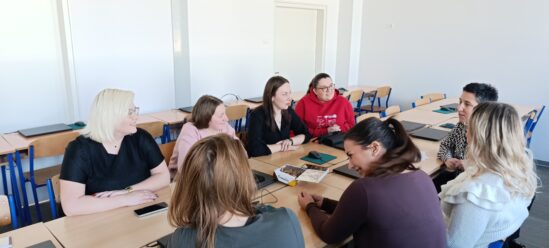
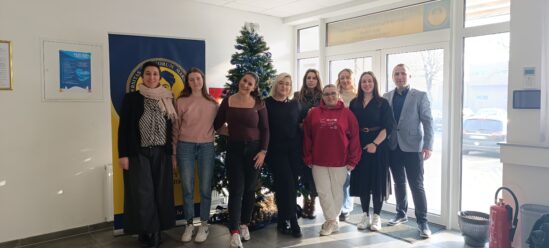
The student part of the conversation gave us concrete insight into how the e-University project spills over into the daily student experience. We spoke with a group of female students from various study programs and levels, actively involved in the University's multimedia and extracurricular activities. The conversation included Matea Milas, a fourth-year student of integrated teacher education, one of the initiators and coordinators of the student podcast; Emily Cesarec, a third-year student of early and preschool education, active in student projects and the student council; Ivana Lovrić Senjak, a first-year master's student of economics, involved in the technical and development support for University projects; Nika Kovačević, Valerija Lučić, Stela Panković, and Ema Bahnik, all fourth-year students of integrated teacher education, who form the core of the student podcast's editorial and production team. Marin, a former student of teacher education who has graduated but remains actively involved in the project, primarily in the technical and production segment, was also mentioned in the conversation, as was student Katarina Aračić, primarily responsible for editing and post-production of video content. Their story didn't begin with project applications or formal invitations, but with a very simple situation – encouragement from Professor Šimunović and Professor Cobović, and an invitation through a student Facebook group, via which students learned that the University had a multimedia studio and the opportunity to work outside the usual study frameworks. The key motivational factors were the professors' encouragement and their willingness to offer students space and available technology, which enabled the organic development of the initiative and creative work.
Work organization and editorial model
Our conversation was mostly about UNICAST, in which, as we learned, there are no hierarchically defined role divisions, but rather responsibilities are assumed according to interests, availability, and personal affinities. The female students emphasized that “everyone does everything,” but in practice, it is clear who is inclined towards conducting interviews, who towards technical preparation, and who towards post-production. Such a work model allows for a high level of flexibility but also develops a sense of shared responsibility. For example, Matea naturally profiled herself as an activity coordinator, Katarina is primarily responsible for post-production, and Ema most often finds herself in the role of moderator.
In one year, or by the time this text is published, 13 episodes have been produced, at a pace that the students themselves have deemed realistic and sustainable (approximately one episode per month). This pace is primarily dictated by the students“ commitments outside of the podcast: classes, exams, part-time work while studying, participation in numerous other activities (choir, drama activities, student radio, and other initiatives). It is precisely this multi-faceted involvement that creates the context in which the podcast is not perceived as an ”additional task," but rather as one form of student activism.
Production process and learning through practice
The students very clearly identified post-production (editing) as the most demanding and time-consuming part of the process. Although most of them do not participate directly in editing, they are aware that this particular part – cutting, structuring, transitions, sound effects – determines the professionalism of the final product. In other words, the students are aware that the quality of the content is not solely based on the quality of the conversation, but on the thoughtful processing of the material after filming.
The preparation for the recording is described as minimal and intentionally unstructured. The students use notes and thematic frameworks, but avoid reading questions or strict scripts. Emily emphasizes that this approach results in more natural conversations and greater authenticity, which she considers key for a student audience. This clearly reflects on the media format: the podcast is not seen as a lecture or an informative broadcast, but as a conversational space where knowledge, experiences, and opinions are shared in a relaxed yet meaningful way.
Public and topic selection
UNICAST's primary audience is students, and the choice of topics often stems from questions students themselves ask or from what they've stated they “would like to watch or listen to.” Episodes with the rector (due to symbolic importance) and a Q&A episode for freshmen, where female students answered questions based on their own study experiences, were highlighted as particularly successful. This format proved to be a valuable tool for transferring informal knowledge that is often missing from official communication channels. Additionally, Ema mentions episodes with international guests (e.g., professors from Ireland and Spain), which presented an additional challenge for students in terms of language and preparation, but also a strong experience of professional growth, and episodes about healthy living and mental health, which are extremely important for student life.
Impact on Teaching and Professional Competencies
One of the most important parts of the conversation with the female students concerns transferring skills from podcasting to formal teaching. Valeria emphasizes the importance of creativity in the teaching process and connects the podcasting experience with the development of competencies required for future teachers. Additionally, her colleagues provide concrete examples where, thanks to their experience working in the studio, they have more effectively carried out teaching tasks (e.g., creating educational videos as part of methodology). In this regard, the podcast represents an informal laboratory for pedagogical and communication competencies. They particularly highlighted the studio's potential for recording teaching content that could be used as part of courses, especially for distance learning students and in courses with a strong procedural component (e.g., calculations, statistics). The female students clearly recognize the value of being able to re-watch and revisit procedures, which they associate with a better understanding of the material.
Student life, engagement, and real challenges
In our conversation, we openly discussed the broader context of studying in Slavonski Brod. The female students recognize the advantages of a smaller university: better connection with teachers, less anonymity, and greater mentor accessibility. At the same time, they are aware that Slavonski Brod is not a “classic student city” like Zagreb, Osijek, or Split, and that student life requires more personal initiative. They particularly emphasized that active student engagement is often limited to a small number of students, while the majority remain focused solely on fulfilling their academic obligations. The students point out that precisely because of this, projects like podcasts have added value: they create a core of engaged students, strengthen the sense of belonging, and enable the development of social and professional networks.
Vision of the Future: Connectivity, Platforms, and Interdisciplinarity
One of the most conceptually interesting parts of the student discussion was the idea of a platform for connecting students based on interests and hobbies, regardless of their study program. As students from the Faculty of Veterinary Medicine of the University of Zagreb previously mentioned, and to which the students themselves referred, there is a perceived lack of a common space for student networking and connection. Ivana, the originator of the platform idea, highlights the need for visibility of student interests, which often remain “invisible” within formal study structures. Such a platform, according to their vision, would have a dual value: on an individual level, it would enable students to connect, and on an institutional level, it would provide insight into the community's potential and future development directions.
Conclusion
The experience of implementing the e-University project at the University of Slavonski Brod shows how infrastructural investments, professional development of teachers, and student engagement can be connected into a coherent and development-oriented whole. A stable network infrastructure and thoughtful equipping of spaces, along with the continuous participation of university staff in CARNET and other training programs and inter-university networking, created conditions in which student initiatives like UNICAST evolved into sustainable projects with clear competency outcomes. Student testimonials on transferring acquired skills to formal teaching, as well as on strengthening professional identity and a sense of belonging, confirm that this is a systematically managed process of institutional learning. The e-University project is thus confirmed as an effective integrative framework, but its true reach becomes visible through the dedication of professors and staff, the openness of the administration, and the initiative of female students at the University of Slavonski Brod, who have shown how a technological impetus can be transformed into living and sustainable academic practice.
The text is the copyrighted work of a CARNET employee, and the views and observations expressed do not represent the official position of CARNET.