

Reportage
Author: Dr. Klara Bilić Meštrić
It's a warm June day, and the atmosphere around the Faculty of Veterinary Medicine at the University of Zagreb isn't tense, even though it's exam season. Students are chatting in small and larger groups on the faculty grounds, looking cheerful and merry. Given the positive vibe, it seems more like they're anticipating a big party the following day than worrying about exams themselves. The language drifting from these groups is often English, but also French and some others that can't be immediately deciphered.
In agreement with the head of the Histology and General Embryology course, Full Professor Snježana Kužir, I will come a little before 10 to the Faculty to interview Bachelor's and Master's integrated study students of Veterinary Medicine in English who have accepted the use of the assigned multimedia equipment. through CARNET's e-University project – a study for recording contemporary teaching video materials in a very specific context – recording video lessons / podcasts – by describing scanned histological preparations using Instagram photos.
A little context
For those who haven't heard, it's worth mentioning that CARNET has been implementing the e-University project since 2022, with the aim of digitally transforming higher education in the Republic of Croatia by improving digital teaching infrastructure, introducing digital teaching tools, and strengthening the digital competencies of teachers for teaching in a digital environment. As part of the project, it was also carried out pilot study (2023 – 2024) in collaboration with the University Computing Centre Srce and 21 higher education institutions from the Republic of Croatia. While the pilot research previously placed greater emphasis on monitoring the use of digital technologies, the application of technology in teaching, and testing assigned equipment, the pilot continued in 2025 through action research. Application of multimedia in higher education, and our desire was to further empower students and encourage their active role in the application of technology in the teaching process. Namely, research, as well as experience, shows that the biggest change in educational processes occurs when students themselves take an active role in their education.

Once you find the right building, the main one, in the cheerful labyrinth of the Faculty of Veterinary Medicine, you can't miss the e-learning office – all paths lead to the studio that was created through the e-University project!
The Role of Students in Project Implementation
Although institutions with teacher education programs (University of Slavonski Brod and Faculty of Humanities and Social Sciences University of Split) or individual students included (Faculty of Medicine University of Zagreb) showed a high level of student engagement with the assigned equipment during the pilot phase and significantly increased equipment usage, most participants still believed that their active involvement could face obstacles and that additional support from CARNET and the partner institution Srce is needed for active student engagement with the assigned equipment. And that is why Professor Kužir's invitation a few weeks ago brought a lot of joy and is the reason for writing this report.. The professor called to tell me that she offered second-year veterinary students the chance to record teaching units and describe scanned histological slides, which the international students accepted and have already started recording. Thus, the students will be creating content for future generations of new international and domestic students at the Faculty of Veterinary Medicine.

No, this isn't a GenZ t-shirt's new hipster design. It's a scanned bird blood smear pattern!
Foreign veterinary students
In the premises of the e-Learning Office, where the recording studio is also located, I was welcomed by Professor Snježana Kužir, Ph.D., from the Department of Anatomy, Histology, and Embryology, and Marko Poletto, D.V.M., Head of the e-Learning Office, the head of the Faculty's Central Library, Jovana Ivanić, and six foreign second-year students of the Faculty of Veterinary Medicine – Mia, Olivia, Finley, Erik, Jad, and Maja. We talked for a little over an hour and covered three main topics: first, I was interested in who the students were and why they came to study in Croatia; then, we compared the educational systems they came from with the Croatian educational system; and in the third part of the interview, we discussed the application of technology in teaching, i.e., the use of assigned equipment through the e-University project.
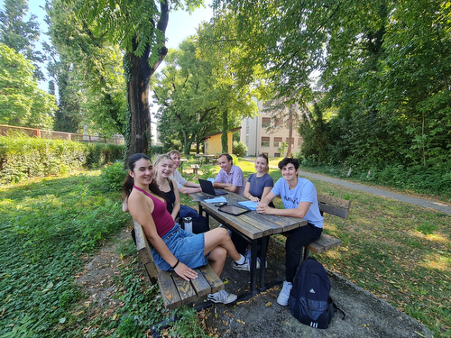
Students from left to right: Mia, Olivia, Finley, Erik, Maja, and Jad – 24 time zones covered
Motivation for studying in Croatia
Students first shared their specific reasons for enrolling in the Faculty of Veterinary Medicine in Zagreb. First, she answered me Mia (Japan/Australia). Mijin's father grew up in Australia, where his parents came from Croatia. However, Mia grew up in Japan. She was looking for English-language programs around the world and stumbled upon Croatia, applied, and got in. She especially likes Intensive, small group classes, which enables individual approach of the professor. Namely, 32 second-year students were divided into three groups of about ten students each.
Olivia is originally from the USA, but grew up in English. Her arrival in Croatia she described as “accidental” and “without any particular story,” but as a study enthusiast. In a conversation with Professor Kužir, she herself emphasizes that it is very important that the Faculty of Veterinary Medicine is a member The European Association of Establishments for Veterinary Education, but also the fact that it's easier to enroll in Croatia than elsewhere, along with the possibility of working anywhere after graduation. He is surprised that in Croatia students can address professors by their first name (and I am surprised too:)) and in general relaxed communication, especially after the Private Education System in England.
Finley, coming from the same system, reports that he did not have a sufficient average to enroll in English universities. He decided to retake the state matriculation exam (so-called A-levels in England), and in the meantime, he began to consider European universities, hesitating between Budapest and Zagreb. Thanks to a school friend who moved to Zagreb earlier, he came to visit and He liked it so much that he decided to study in Zagreb himself. despite receiving an offer to study in England in the meantime.
After Finley, we are addressed by Erik who came from Germany. His decision to come to Zagreb was very quick because he didn't worry too much about university applications while taking his final exams. When the exams were over, most deadlines for European university applications had already passed, so his options were Budapest or Zagreb. Budapest offered a German-language program for the first two years, after which he could transfer to Germany, but Erik's wish was step out of the “comfort zone” and your own language environment And that's what decided him to enroll in Veterinary Medicine in Zagreb.
Treason from Lebanon He tells us about the Lebanese education system. As it is a former colony, the system is similar to the French one and it is very difficult to be admitted to study. Preparations last two years, and entrance exams are rigorous. As with most of his peers, the reasons are also personal, human – his cousin already graduated from university in Belgium and is successfully building a career – this further motivated him to seek a university in Europe. As with Finley, in Croatia he finds I like the relaxed and friendly atmosphere.
in the end I also meet Maja from Canada. She cites as the main reason for her arrival Croatian parentage tea a long-standing desire to live in Croatia. She found the Veterinary Medicine program online and it was the only faculty she applied to. She emphasized that easier to enroll than in Canada because foreign students are preferred there due to the income their tuition brings to the studies, and that Studying in Croatia is significantly cheaper. but anywhere in North America (stating that a year of study in Canada is equivalent to 6 years of price in Croatia). She emphasizes that her parents were very happy with her decision because it will help preserve and transmit the Croatian language and culture.
Comparison of educational systems
After introductions, I asked them to compare the educational systems and teaching methods in their home countries/countries of origin and in Croatia. When I inserted the transcript of our interview into Google Notebook and asked it to recognize patterns, it accurately identified the topics that the students felt the need to discuss:
Professor support
A theme that had already crept into the conversation concerned the relationship between professors and students.. Mia She was educated in the private English-language education system in Japan and is aware that she received an excellent education. She states that they had a developed system with a lot of technological and material resources. However, she points out that at the Faculty of Veterinary Medicine in Croatia, the relationship between professors and students is much “FRIENDLIER AND LESS HIERARCHICAL negotiations in Japan, where there is a strict hierarchy and a special language for talking to superiors. She believes this closeness has a very positive impact, especially on international students. Olivia she added that she herself came from the private education system, and she herself was surprised by the possibility of addressing professors by their first name and the level of informality in communication, which, in her words, was unimaginable for her in a private school in England. Erik, although he points out that the educational systems are very similar, he notes that in Croatia professors “guide students through their studies, while In Germany, students are left to their own devices.
Flexibility and online learning
Finley first mentioned the problematic nature mandatory attendance at all lectures in Croatia (often from 7 or 8 in the morning), which on one hand is considered good because you have to be present and attend lectures, while on the other hand, such a system is considered too rigid. Olivia also advocates for greater representation of online learning, which was available in the UK and would be useful in cases of illness and family emergencies, especially for international students. In that regard, they lack more flexibility and understanding for the specific needs of international students. Professor Kužir, and a little bit myself, explain how hybrid teaching is still unregulated in Croatia, but that with the help of the equipment and hybrid hall that will be allocated Through the e-University project, lectures can be recorded as additional material, which means that students will have access to materials if they miss classes.. Mia I'll build upon this topic to explain how lecture recordings with scans of specimens would make studying easier for all generations of students, which is actually the goal that Professor Kužir has set for herself.
University integration
Finley he had the need to talk about how he feels lack of connection and integration among faculties within the University of Zagreb, which gives them the impression that the Faculty of Veterinary Medicine is “its own separate university” and that the only people they interact with and meet are people from the Faculty of Veterinary Medicine. The professor drew their attention to the first student magazine of the University of Zagreb Veterinarian Which is the same place for networking and connection, but also the possibility horizontal mobility – attending elective courses at other faculties to earn ECTS credits and meet other students. Although I got the impression that they are not lonely and have a social life, they all somehow followed up on Finley's comment, and it still seems like there's a fear that they live in some isolated microcosm of the Faculty of Veterinary Medicine. When I pointed out that there are Erasmus student associations, they reminded me that Erasmus students are only here temporarily, while they themselves spend their entire studies in Croatia.
Technology and Practical Work
Erik he is surprised advanced technology At the Faculty of Veterinary Medicine in Zagreb, comparing it to Germany where only private faculties and private clinics have better equipment and therefore have an advantage over state institutions. It describes as a problematic example how students at state faculties in Berlin do not have access to night emergencies precisely because of the lack of such resources, while the Faculty of Veterinary Medicine in Croatia is a state institution and, at the same time, the best veterinary institution in Croatia. Jad thinks that Croatia is much more technologically advanced in relation to Lebanon.
Quality of teaching and organization
Experiences with teaching quality vary significantly. believes that teaching methods in Lebanon A little better in terms of the explanation and demands of the educational system and the fact that Everyone speaks three languages. Olivia and Mia stand out large differences in quality within the faculty itself, to which other students added and spoke very highly of colleagues such as Histology, Anatomy, Chemistry and Biochemistry, and Physiology. They are praised for their excellentgenuinely incredible) lectures, good organization, and the professor's willingness to answer questions. Finley It is noted that courses with a lot of ECTS credits are often also the most interesting ones. However, they believe that some other departments do not have lectures organized as well, and they find it difficult to see the point of seminar classes for courses they deem less important, where they waste a lot of time on passive reading and preparing presentations.
Oral exams
And to conclude the comparisons, Maja He emphasizes that oral exams a stark difference compared to Canada, where there are none at all. Although she considers them extremely stressful, Maja admits that they are useful because they material is better remembered.
Using multimedia equipment in the Faculty of Veterinary Medicine
In the third part of the interview, we discussed their experience. using a studio for podcast recording.
Initial discomfort and motivation for filming
It's interesting how students invited each other to film recording sessions to reduce discomfort and overcome fear. Mia She told us how she felt at first about the very idea of recording in the studio – „Scary idea… no one’s really done that before.”and if she asked Olivia so she could join her to make things easier. In the end, they were both happy they agreed to the recording, and it felt like “a conversation with a friend in a small, cozy room” (this is a so-called. studio in a box – recording studio for podcasts, lectures, video lessons, etc.). The toad, whom Finley had summoned, shared that he wasn't particularly keen on that idea at first, especially if the recorded material ended up online. Finley He also pointed out that the first invitation to participate (he was invited by Olivia) in the podcast sounded like there would be a lot of work involved, which discouraged him even more. However, The pivotal moment for everyone was the conversation with Professor Kužir, who encouraged them („You can do this”) and spurred them to change their minds. The realization that it's mostly an audio recording, not a video recording of themselves It further eased their initial fears and helped them gain a new educational experience.
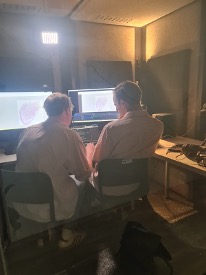
The guys are recording digital educational content / describing cheerful pink patterns.
Positive experience and learning through recording
Besides enjoying the process, they also recognized the educational benefits of this type of work. Jad He experienced filming as a new approach to learning and expression doctor Mia believes teaching is one of the best ways to learn because it helps reorganize thoughts and understand topics more deeply by explaining them (cheerfully notes that she learns by teaching her cats and boyfriend in online meetings). Maja she confirmed that through preparation and recording, she learned the material to the extent that she could reproduce it without problems on the exam: „Now I can clearly identify this preparation. If I get it on the exam, I'll know everything about it.” She also added that she wished such an option had existed earlier because then she would have learned even more by recording descriptions of preparations from each lecture.
However, it's not a process that works perfectly the first time. After each recording, the professor had corrections through which the students also learned. Although the process was fun and full of laughter, The final content had to be professional and error-free.. Olivia concludes that they simultaneously greatly had a good time and did something important for themselves and the academic community.
Using Artificial Intelligence (AI) and the Meaning of a Support Team
The filming process also included scriptwriting, what is, as it explains Olivia, thanks to the help of artificial intelligence, it was significantly easier, especially since the recording was at the end of the semester, just before the stressful period of exam deadlines. It was interesting to see that students were aware of the technical and time requirements of pre-production and post-production for creating digital educational content, so they were relieved when they realized the professor had IT support and that a colleague Marko Poletto, Head of the e-Learning Office, to lead the process and edit all the material. Although everything seemed quite stressful and demanding at first, the available tools and support made it all go smoothly. As with the pilot research before, it once again showed that creation of digital educational content is a process that requires time and teamwork.
The Importance of Professional Support and Digital Resources
Maja She emphasized that although it's technically possible to record with a mobile phone, a professional studio still offers significant advantages, especially the ability to visually display the specimens, which she considers extremely useful for all generations of students. The scans of the preparations are stored on the platform Vrančić, are marked with a CC license and are accessed via a link on the official website Institute of Anatomy, Histology, and Embryology, with the prior agreement that they would be freely available for promotional and educational purposes.
Students also noticed certain infrastructural challenges, such as a lack of English-language books in the library. The head librarian, Prof. Jovana Ivić, explained that the main reason for this is a limited budget, but both she and Professor Kužir pointed out to the students the availability of numerous free online resources. In response to this challenge, there are plans to develop a digital repository of library materials, inspired by the practices of modern universities that rely heavily on digital educational materials (Professor Kužir provided an example of the digital library at the Faculty of Veterinary Medicine in Ghent).
Further digitalization processes at the Faculty of Veterinary Medicine
Professor Kužir informed us about further plans related to the digitization of materials that will allow students to study from home or abroad, as the content will be open and licensed for free use. Although it is a long-term process—she states that processing all specimens will take up to five years—it is expected that future generations will benefit from the increasing amount of audio and video content. The plan also includes recording practical classes, which will be combined with scanned slides to enable hybrid learning. This approach will be further enhanced with new equipment from the e-University project, expected after the new year.
At the end of the interview, we invite students to join us for THECUC-u, who, as their professor presented him to them: A meeting place for professors who are pushing the boundaries of teaching. The professor and I thank the students, and they thank the professor for giving them the opportunity to be part of this initiative.
And in the end…
I am leaving the Veterinary Faculty infected (the choice of words is intentional, editor's note) with the same spirit that overtook me – warm and cheerful. I am thinking about how the key role in this story belongs to Professor Kužir, Marko, and Jovana, who recognized the potential of their students and decided to give them the opportunity not to be just passive recipients of knowledge, but active content creators.. Through trust and openness, they have created an environment where students simultaneously develop professional, digital, communication, and presentation skills, and above all, a sense of belonging and security. Thus, the studio at the Faculty of Veterinary Medicine is not just a recording space – it is a place of meeting, collaboration, and co-creation of knowledge. Here, students not only learn subject matter but also gain experience by participating in contemporary education that recognizes their perspective and voice. I am thinking about Professor Kužir's sentence regarding professors who come to THECUC, about how enthusiasm and expertise connect people into great teams, resulting in practices that go beyond usual teaching frameworks. And more broadly, as many of CARNET's stories have been so far, how The e-University project shows that digital transformation in education is not just a matter of infrastructure, but a deeply pedagogical process in which people and their interconnectedness have a central place..
However, I also see how much work lies ahead of us – great effort and considerable financial resources have been invested, and the institutional frameworks in which instruction and creation of digital educational content will be recognized and valued as an essential element of progress and development – both individual and institutional.
The text is the copyrighted work of a CARNET employee, and the views and observations expressed do not represent the official position of CARNET.