

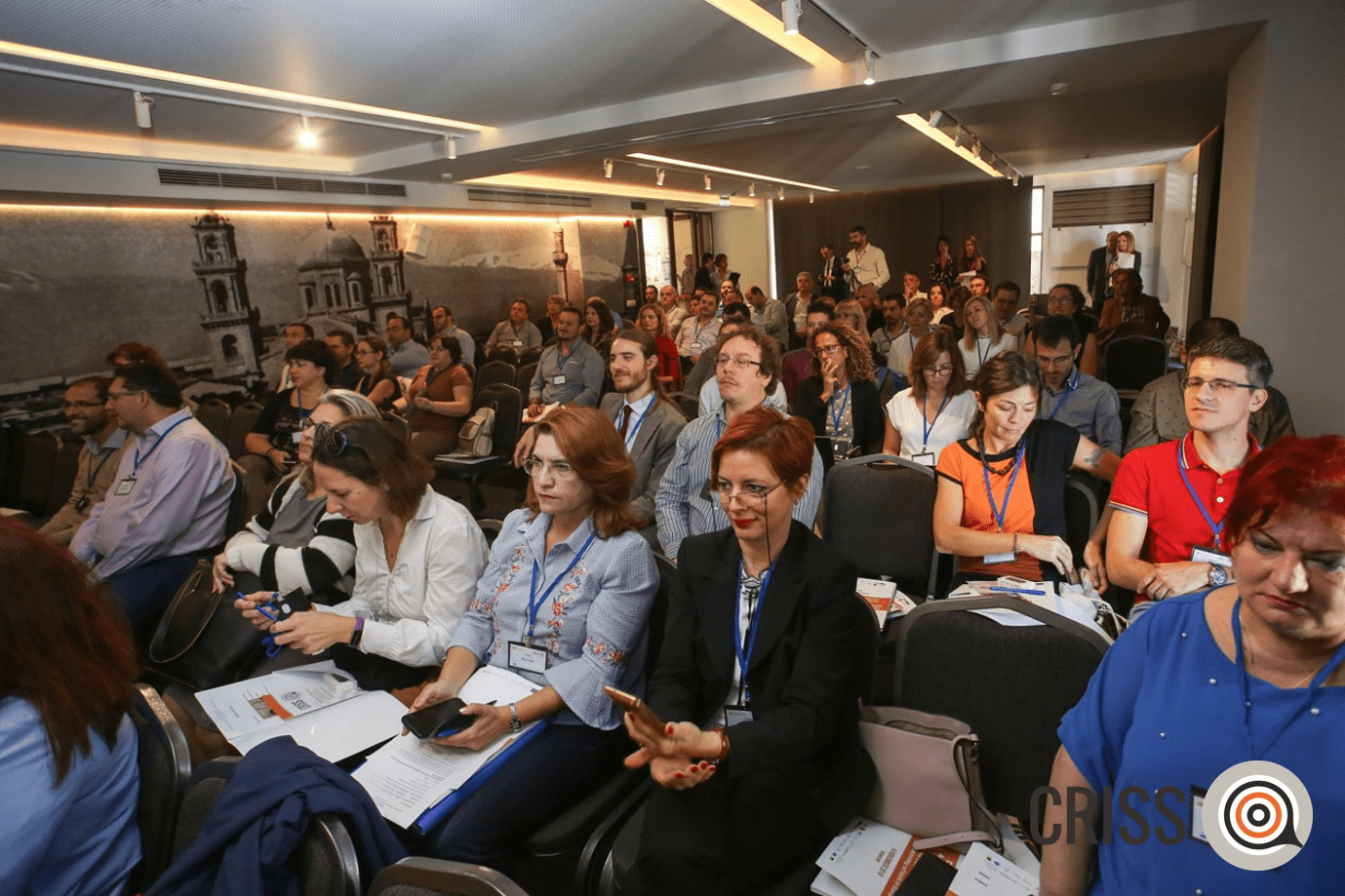
Within the CRISS project, the final symposium on digital competence adoption was held on November 14, 2019 – Symposium on Acquiring Digital Competence in the Classroom: The Experience of Primary and Secondary Schools in Europe in Heraklion, Crete.
In addition to invited speakers and politicians, teachers from Italy, Romania, Sweden, Greece, and Spain also participated in the symposium. Croatia was represented by two teachers, Marina Vukančić from Ive Andrić Elementary School in Zagreb and Jasmina Kljunić from the School of Administration in Zagreb. Their students achieved the best results in Croatia regarding the development and acquisition of digital competence. These were not only the best results in Croatia but also in Europe. Their success garnered significant interest and recognition from European partners, leading to invitations for further collaboration on European projects related to the development of digital competence in education. Teacher Jasmina Kljunić impressed everyone present with her work, as she is the only teacher who successfully completed all ten study scenarios within one school year with her students, which are necessary for earning a comprehensive digital competence certificate. In addition to their work on certifying and evaluating digital competencies, the Croatian teachers were the only ones to test the mixed reality program (Magellan). As part of their presentation, they showcased their experiences and their students' work with Magellan.
As part of the symposium, Greek partners held a ceremonial award ceremony for all Greek schools involved in the CRISS project, thus bringing a successful conclusion to this initiative and recognizing the effort and work of the schools and teachers, who were the main driving force behind the project. The award ceremony was highly publicized, and all teachers who participated in the project received plaques and recognition.
In addition to teachers, other invited guest speakers participated in the final symposium – the Deputy Minister of Education of Greece, who also presented awards to the Greek teachers, advisors from the European Commission, and scientists from the field of education and educational digitalization.
We would like to highlight several presentations related to the digitalization of education, which can be connected to the Croatian educational context and CARNET's activities related to e-Schools and projects in which CARNET has had a prominent role so far.
Lecture Digitally competent educators Professor Airine Volungevičienė Vytautas Magnus University of Lithuania presented projects dealing with the digitalization of higher education. Vytautas Magnus University is highly digitally developed, and all courses, attended by a total of 10,000 students, are conducted in a digital environment as well (via the Moodle system). The professor highlighted the challenges of assessment in education that takes place in both real and digital environments and presented a project as a potential solution. TeSLA – Adaptive Trust-based e-assessment System for Learning funded by the European Commission through the Horizon 2020 science and innovation program, whose purpose is precisely to bridge the aforementioned challenges through authentication and biometric recognition tools for access testing.
Besides TeSLE, another project related to higher education and digital support presented by Professor Volungevičienė was also funded by the European Commission's Horizon 2020 program for science and innovation. This project is called Slide Wiki which functions as a platform for raising, sharing, and evaluating higher education teaching materials and for collaborating on them, and is closely related to Area 2 of the European Digital Competence Framework for Education (Digital Resources).
Two guest speakers presented projects related to central activities in the European Commission. As part of the presentation Innovation procurement by public bodies in Europe, Ane Lucíe Jaramillo, Senior Legal Advisor from the European Assistance for Innovation Procurement (EAFIP) initiative, presented support measures in preparing innovation procurement processes.toolkit. The third call for preparation support is currently open, with a deadline of December 13th. Considering the project activities within CARNET, as well as more broadly in Croatia, this initiative represents an important step forward in the assistance provided by the European Commission in preparing public procurement implementation processes in the field of innovation.
The second lecture from the European Commission focused on future calls within the Horizon 2020 program related to the digitalization of education. Marcel Watelet, a representative from the Commission's Directorate-General for Communications Networks, Content and Technology (DG CNECT G2), specifically highlighted CARNET's leading role in piloting the CRISS project. He announced projects planning systematic investment in the development of digital competencies in education.
Call for the next project worth 1 million euros, Socioeconomic and Cultural Transformations in the Context of the Fourth Industrial Revolution, it is open until March 2020, and a large multi-million euro call for structuring education in the European Union is also planned, for which is currently underway needs assessment educational professionals and public policy makers.
All presentations from the Symposium are available at the following link www.crissh2020.eu/criss-symposium/.