

The workshop began with an introductory overview of artificial intelligence development, in which the students presented key historical and conceptual points. They spoke about the origins of artificial intelligence and Turing Test as one of the first attempts to determine if a machine can imitate human communication to a human-indistinguishable level. They highlighted how the difference between a machine's and a human's response has been decreasing over time, especially with the development of modern generative models.
As an important milestone, they cited Dartmouth Conference of 1956, which is considered the beginning of artificial intelligence as a separate scientific discipline, with the ambitious goal of developing machines that can imitate human thinking. The students also explained the work on perceptron, one of the first machine learning algorithms, which marked the beginning of the development of models that learn from data.
In the historical overview, the so-called periods were also touched upon. „AI has“, when interest in artificial intelligence significantly declined due to limited results and lack of funding. They emphasized that the field began to redevelop in the 1980s, particularly through investments in Japan and the USA, and then experienced a strong surge in the early 21st century.
Through examples such as Mycin-a, The students demonstrated how AI systems have begun to be applied in medicine, engineering, and other fields, using a running expert system for medical diagnostics as an example. They particularly highlighted the rapid development of artificial intelligence in recent years and its omnipresence in everyday life.
The participants were presented with a series of examples that we use daily: automatic text correction, facial recognition, product and content recommendations, voice assistants like Google Assistant, Alexa, and Siri, chatbots, navigation systems like Google Maps, smartwatches, and the development of autonomous vehicles. In this way, they showed that artificial intelligence is no longer a futuristic concept but a technology that is already deeply integrated into everyday activities.
In the final part of the introduction, they also opened up key ethical issuesprivacy protection, accountability in case of system errors (especially in medicine), the use of artificial intelligence for military purposes, and the risks of manipulation and the spread of disinformation. In doing so, the students emphasized the importance of a critical and responsible approach to the development and application of artificial intelligence.
After the introductory part, the practical part of the workshop followed, in which three concrete tools intended for teachers were presented: Magic School, Brisk Teaching i SchoolAI. The students demonstrated the basic functionalities of each tool through short demonstrations and guided activities, with a special emphasis on their application in everyday teaching.
Participants had the opportunity to see how Magic School can help with creating lesson plans, assignments, and student feedback, how Brisk Teaching supports rapid analysis and adaptation of teaching materials, and how SchoolAI enables the creation of interactive activities and personalized assignments for students. The workshop was designed as a practical overview of tools that can make teaching organization easier for teachers and save them time, while maintaining pedagogical control over the teaching process.
The special value of the workshop was precisely in the fact that it was led by students – digital ambassadors. Laura Fabrični and Magdalena Marok. Their role in this context clearly demonstrates one of the project's fundamental goals: to empower students to become active participants in the school's digital transformation and partners with teachers in understanding new technologies.
As part of the meeting, besides the project activities „Digital Ambassadors for Students“, the key project activities were also presented to the participants Brain, with an emphasis on the research and development components related to the application of artificial intelligence in education. Teachers were invited on this occasion to participate in the implementation of project activities and thus contribute to the development of teaching practices based on modern digital and AI solutions.
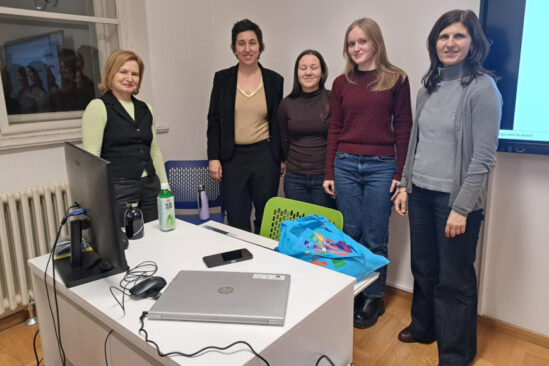
The workshop was held in an interactive and stimulating atmosphere, and participants had the opportunity to ask questions, try out tools, and exchange experiences. Such meetings confirm the importance of projects like „Digital Ambassadors for Students“ i Brain, which, through the collaboration of students, teachers, and research teams, builds a culture of responsible, safe, and creative use of digital technologies in education.