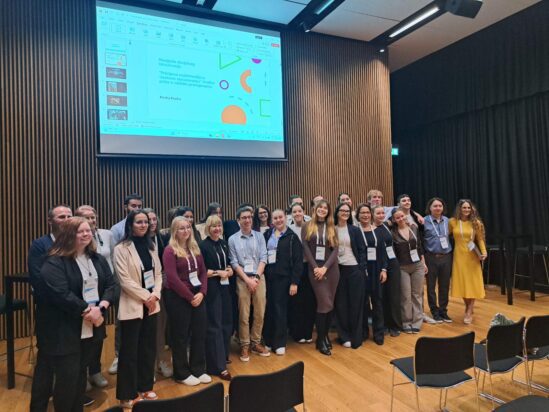
Participants of the action research “Application of Multimedia in Higher Education” from the e-University project at CARNET's User Conference THECUC 2025
The legacy of action research and a collaborative framework for change
THECUC 2025 brought together various members of the academic community, faculty, IT professionals, librarians, and students, who demonstrated through action research and practical work how the digital transformation of higher education is taking place in real classrooms, laboratories, and studios. The central thread connecting all the presented examples is the multi-year investment in developing the competencies of teams of faculty, librarians, and IT staff, mentoring support, and digital infrastructure through the first pilot research (2023-2024), and then the action research „Application of Multimedia in Higher Education“ within the e-University project (2024-2025). It was precisely the action research that created the methodological and organizational framework within which individual initiatives at different institutions gained full meaning: systematic experimentation, development of pedagogical innovations, inclusion of students in the content creation process, and building an interdisciplinary community of practitioners.
The core message is that digital transformation in higher education is a collaborative process, not a one-off project: it grows through small and large interventions, through institutional leaps, but also through the enthusiasm of teams that research, create content, and test new teaching models. This context was the starting point for all the examples of initiatives presented below.
Examples of real changes: multimedia, new teaching models, and students as digital content creators
The participants of the action research presented a broad and very diverse range of pedagogical innovations, from digital medical education, through mathematical content and legal simulations, to video lectures and podcasts by students from various studies.
In a PechaKucha format (20 slides x 20 seconds), seven institutions presented their work; the Faculty of Organization and Informatics (FOI) team: Magdalena Markovinović and Marin Grabovac (Assoc. Prof. Zlatko Stapić, PhD) showed how e-University equipment can be used to promote innovative teaching approaches such as Work-Based Learning (WBL) and Joint Curriculum Development (JCC), where students take an active role in solving problem situations that mimic real professional challenges. At the other end of the application spectrum, Vedran Vuglić from the University of Zagreb School of Medicine (Assoc. Prof. Mirza Žižak, PhD) demonstrated how a multimedia studio becomes a pedagogical laboratory where asynchronous content, educational multimedia materials, and video lectures focused on students' health literacy are created.
A similar dynamic is visible in the implementation of action research at the University of Slavonski Brod, as demonstrated by the female students. Matea Milas, Katarina Aračić I am Ivana Lovrić Senjak (Asst. Prof. Zrinka Šimunović, PhD, and Asst. Prof. Mirko Cobović, PhD), where extracurricular activities focused on student production have become a space where students from different university programs learn to work in a team, plan projects, use technology, and publicly present their work. Female students from the teaching track of the Faculty of Philosophy in Split, Anđela Bilić; Iva Vrdoljak; Lucija Rodin; Mia Milković; Anđela Prodan; Tara Todorović, (Assoc. Prof. Suzana Tomaš, PhD, and Asst. Prof. Lada Maleš, PhD) demonstrated how through the creation of video lessons and podcasts, they are developing digital and methodological competencies that they will need in the classroom tomorrow, while the example of the Faculty of Mathematics in Rijeka presented by Assoc. Prof. Vedrana Mikulić Crnković, PhD, and colleague Bojan Crnković shows how demanding STEM fields can be improved through a series of small but thoughtful digital interventions that increase the clarity and interactivity of content.
The second paper from FOI, presented by student Eva Petrović (M.Sc. Barbara Šlibar and Prof. Ph.D. Nina Begičević Ređep), showed how the method is used in teaching Flipped classroom Negotiation simulations: students develop communication and analytical skills in a decision-making environment through video recording, analysis, and reflection. As demonstrated by students Marta Laco and Sara Glamočić (Prof. Ivana Kunda, PhD, and Asst. Prof. Dejana Golenko, PhD) at the Faculty of Law in Rijeka, digital tools are used for case simulations, interactive analyses, and working with real legal materials, bringing students closer to the way of thinking required in the modern legal context. The Faculty of Veterinary Medicine in Zagreb also made an impressive contribution, where a group of students – Olivea Lee Hay, Mia Maria Mijatović, Finley Joel Underwood, Jad Chalhoub, Maja Marica Čizmić, and Eric Maximilian Erichorn (Prof. Snježana Kužir, PhD, and colleagues) presented a combination of digital histological slides and student educational podcasts – a learning model in which students, with the help of professors, librarians, and IT support specialists, transform very demanding professional materials into more understandable, accessible, and collaboratively designed digital educational content.
The common thread running through all these examples is evident: teachers and students become partners in creating a digital academic experience, and multimedia is not just used as a tool, but as a means of building confidence, competence, and community.
Other events, workshops, and community building: THECUC as a living lab
THECUC 2025 was also marked by a rich network of workshops, panels, and BoF discussions that further illuminated the broader picture of digital transformation, in which the action research participants showed significant interest and also participated in their conceptualization.
At the ceremonial opening of the conference, which was conducted in the form of a dialogue with various higher education stakeholders, two students from the University of Slavonski Brod, Matea Milas and Ivana Lovrić Senjak, also shared their perspectives. The students emphasized the importance of including students in CARNET's conference for higher education and highlighted the need for a networking platform for students and student conferences on the topic of digital transformation in higher education. In addition to the students, professors who participated in the action research also spoke at the ceremonial opening. Assoc. Prof. Dr. Suzana Tomaš from the Faculty of Philosophy in Split emphasized the importance of the service Digital maturity of higher education institutions, a concept that has the power to further motivate higher education institutions to develop digital maturity. Assistant Professor Mirko Cobović, Ph.D. also concluded that the e-University project is a strong incentive for the changes necessary in the system to achieve digital maturity in higher education institutions.
Participants in the action research showed great interest (and an already enviable level of knowledge) in multimedia workshops, as well as in demonstrations dedicated to MultiLab environment, during which participants were introduced to the concept of multifunctional, educational, and innovative spaces that will be available to the academic and educational community in the university cities of Osijek, Zagreb, Rijeka, and Split. In addition to Multilab, through numerous events, participants of the action research were also presented with the concepts of the CARNET Academy and educational program, as well as CARNET's Portal, which will offer a wealth of content and podcasts focused on the application of technology in education through original articles and guest appearances by members of the academic and wider community involved in reflecting on the application of digital technologies in education.
Through a panel session on evaluating the development of digital competencies and digital educational content in the higher education system, a direct result of the dialogue with action research participants and their guidance of the e-University project's development, key stakeholders in science and higher education (Ministry of Science and Education, Agency for Science and Higher Education, University of Zadar, and University of Rijeka) participated. It became apparent that the development of competencies and the quality of materials must be viewed as interconnected dimensions of teaching in the post-digital age. Furthermore, it was concluded that stronger collaboration and intervention from stakeholders in public university policies – the Rectors„ Conference, the Ministry of Science and Education, the Agency for Science and Higher Education, and the National Council for Higher Education, Science, and Technological Development – are necessary to establish digitally mature institutions and to institutionalize the evaluation and reward of staff who actively use resources allocated through the national e-University project. The “Can We Do Better?" BoF session held by the University Computing Centre (Srce), a partner institution in the project and action research (lecturer Sandra Kučina Softić, PhD, and colleagues), particularly captured the interest of students, with students and faculty passionately commenting on their daily teaching experiences.
The action research participants made a significant contribution to the conference: Assistant Professor Mirza Žižak, PhD, along with student Vedran Vuglić, presented research on students„ attitudes towards artificial intelligence in medical education and demonstrated the use of automated imaging systems through an additional workshop. From the same faculty, docent Lea Škorić, PhD, moderated a discussion on the prerequisites, challenges, and sustainability of open science in the Croatian environment during the panel “Open Science in Practice." Within the framework of the panel, CARNET's role in developing resources necessary for open education through the e-University project was highlighted: from (1) the LMS Loomen, (2) repositories for storing and sharing video content Jellyfish 3 digital educational content Tutorial, whose new version will provide teachers and other higher education employees with the opportunity to publish, review, and share digital educational content, in addition to the previously mentioned (4) physical MultiLab spaces with various innovative technological solutions that will be available to teachers and other higher education stakeholders in four university cities.
A special feature of THECUC 2025 was the presence of students, who marked almost every segment of the program: participation in panels, authorship of workshops, PechaKucha presentations, discussions on teaching quality, and informal gatherings. Their energy, openness, curiosity, and creativity made the conference a shared experience and showed what a community that lives digital transformation looks like – not just in theory, but in all content elements, including the dance floor. 🙂
THECUC 2025 has concluded, but the action research continues. In the coming weeks, the Follow-up activities, calls for new workshops, and opportunities for students and faculty to engage in further research steps. Together, we continue to build open, digital, and inclusive higher education.