

E-learning Academy
From 2004 to 2014, CARNET conducted a training program for e-learning specialists called the E-learning Academy. The program was created in collaboration with CARNET and the University of British Columbia from Canada. 543 participants completed the program over 11 cohorts. In an effort to elevate this program and the knowledge and skills related to e-learning to a higher, university level, CARNET began negotiations with the University of Zagreb regarding the launch of a university program on e-learning. For this reason, the program is no longer offered at CARNET.
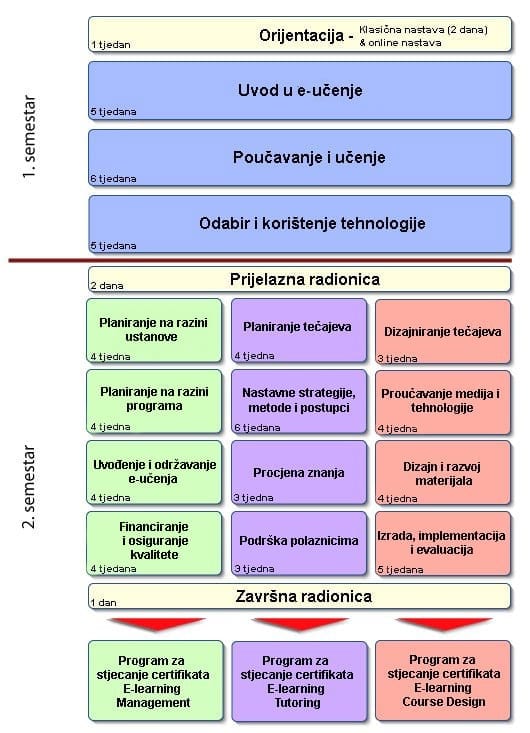
As part of the E-learning Academy, three one-year programs were held in collaboration with University of British Columbia from Canada.
Each program lasted one academic year, or two semesters. The first semester was common to all three programs and consisted of three courses, dealing with general topics related to e-learning, pedagogy, and technology in teaching.
The second semester consisted of courses dealing with topics specific to each of the programs. The teaching for all three programs took place online, with three in-class workshops spread across both semesters.
Programs
E-learning Management
The E-learning Management program was designed for everyone who wants to gain practical experience in creating e-learning projects in a team and remote environment, and was based on participatory classroom methods and online environment.
After completing the E-learning Management program, participants can:
- consider the innovativeness of your project ideas and connect them with strategic European and institutional plans
- Plan projects and related resources (people, time, finances)
- prepare project documentation, including the project timeline and cost estimate
- plan organizational models to support students and teachers
- Define existing and desired individual and group competencies.
E-learning Tutoring
The E-learning Tutoring Program was designed for everyone involved in planning and maintaining teaching, who wish to enrich their practice by incorporating technology.
The program covered topics from the fields of pedagogy, psychology, sociology, and communication sciences.
After completing the E-learning Tutoring program, participants will be able to:
- Select teaching strategies and methods appropriate for the curriculum
- Devise activities that will ensure the achievement of planned learning outcomes
- monitor the regularity and quality of your trainees' work in online in mixed environments
- to lead teaching activities in online in mixed environments
- perform formative and summative assessment of knowledge in e-learning programs
- Determine what kind of support is needed for e-learning participants.
E-learning Course Design
The E-learning Course Design program was intended for those who wished to acquire the knowledge and skills necessary for designing higher-quality e-learning materials, become familiar with the tools and technologies they can use in teaching, and choose the most suitable ones for their environment. Using project-based and team-based work methods, throughout the semester, participants gained practical experience in designing e-learning materials, from planning to creation and evaluation.
After completing the E-learning Course Design program, participants will be able to:
- design e-learning materials
- Determine the purpose of teaching and define learning outcomes
- Analyze and select an educational technology appropriate for the materials being designed
- Design appropriate educational activities and learner interaction with content, the teacher, and other learners
- Evaluate the quality of e-learning materials
- apply project management principles to the planning, development, and creation of your own e-learning materials.
Colleagues
The first semester was the same for all three programs, while the second semester consisted of courses dealing with topics specific to the program's field.
First semester courses
At the very beginning of the school year, a two-day workshop was held. The goal of the workshop was to provide participants with guidelines related to the program and an opportunity to get to know each other and establish connections with their peers and tutors. Participants received an overview of the courses, as well as an orientation course on WebCT tools for distance learning and an introduction to online learning.
This course introduced participants to the concept E-learning these different approaches to its organization and execution. E-learning it is compared with distance learning and other forms of technology-assisted learning and teaching.
The aim of this course was to introduce participants to the main theories of learning and teaching and to develop a discussion on how each of these theories is reflected in the design and development of effective e-learning program.
In this course, participants learned how to make informed decisions about technology selection for e-learning. The main topic of this course was the complexity of the technology selection process e-learning, which includes analysis of several factors.
- Zemsky, R., & Massy, W.F. (2006). Promise and pitfalls: What happened to e-learning and why? (Introduction). Edupoint, 47(VI).
- McGreal, R. & Elliott, M. (2005). Online learning technologies (e-learning). Edupoint, 37(V).
- Pratt, D. D. (2006). Teaching for today: one solution for all? Edupoint, 48(VI).
E-learning Management Colleges
A two-day Transition Workshop was organized at the beginning of the second semester. The goal of this workshop was to bring together participants for the second time during their studies at the E-learning Academy and to allow them to meet new tutors and the group with whom they would attend the second semester. Participants also familiarized themselves with the content, tasks, and methods of work in the second semester.
In this course, participants learned to identify key issues related to planning and management. e-learning, analyze Croatia's readiness to use E-learning identify motivational factors that influence development E-learning in their own and other organizations.
In this course, participants studied several approaches to determining institutional vision related to e-learning, considered options for obtaining stakeholder support for activities related to e-learning. In addition, participants discussed the organizational culture at their institutions and analyzed the motivation needed to initiate E-learning.
Through consideration of various options e-learning offers, from so-called hybrid learning (classes are partly online and partly in the classroom) to fully online e-learning, this course covers program development and design models online and courses. Participants learned how to evaluate which approach is appropriate for development E-learning at their institution and identify which support issues for faculty and students affect effectiveness E-learning.
In this course, participants evaluated proposals e-learning projects and their development through the consideration of organizational and pedagogical issues related to e-learning, as well as the suitability of individual approaches to supporting teaching staff and students. Participants also studied various funding strategies at the local, regional, and European levels. Upon completion of this course, the program would also be concluded.
The final workshop is a one-day event for all participants from the generation that is currently completing their education at the E-learning Academy. The goal of the final workshop is to allow participants to review what they have learned over two semesters and to reinforce their learning through group work with fellow participants. The final workshop is also intended as an opportunity for participants from all three programs to gather once again, form stronger acquaintances, and potential business connections. On this occasion, participants were awarded certificates for completing their education at the E-learning Academy.
- Bates, T. (2001). National Strategies for e-Learning in Post-Secondary Education and Training. (pp. 33-81). Paris: UNESCO.
- The Economist Intelligence Unit (2003). E-Learning Readiness Rankings.
- Bates, A. W. (2004). Managing technological change: Strategies for higher education leaders. Zagreb, Croatia: CARNet/Benja. (pp. 1-22)
E-learning Tutoring Colleges
A two-day Transitional Workshop is organized at the beginning of the second semester. The goal of this workshop is to bring participants together for the second time during their studies at the E-learning Academy and to allow them to meet new tutors and the group with whom they will attend the second semester. Participants also become familiar with the content, assignments, and working methods in the second semester.
In this course, future e-tutors will be introduced to the basics of course planning, as it is assumed they will be involved in this work or even carry it out themselves. In addition to learning about the instructional design model, participants will define learning objectives and design teaching materials and activities. Their plan for the future e-learning courses teach how to present using concept maps.
This course provides an overview of methods, strategies, and techniques available to all teachers, regardless of whether they are in a traditional or virtual environment. Some methods, such as collaborative learning, are more frequently applied in e-learning environments, and by its application to attendees e-learning courses reduce the feeling of isolation or lack of communication.
The subject of this course is two types of knowledge assessment: formative and summative. Although different in their purpose (one is applied for student development, and the other exclusively for grading their knowledge), these two types share the same principles and methods. The course also considers the use of technology in knowledge assessment, which can contribute to the accuracy of results and save time needed for grading.
In this course, participants will be introduced to the academic and non-academic support that learners need in a virtual environment. Academic support includes learning assistance, which in e-learning e-tutors provide courses. Various departments within the educational institution can be responsible for other forms of non-academic support (administrative, technical support, help with finding or searching for resources...), and e-tutors must establish good communication and cooperation with these departments.
The final workshop is a one-day event for all participants from the generation that is currently completing their education at the E-learning Academy. The goal of the final workshop is to allow participants to review what they have learned over two semesters and to reinforce their learning through group work with fellow participants. The final workshop is also intended as an opportunity for participants from all three programs to gather once again, form stronger acquaintances, and potential business connections. On this occasion, participants were awarded certificates for completing their education at the E-learning Academy.
- Anderson, T. (2006). Teaching in the context of online learning. Edupoint, 41(VI).
- University of Victoria Counselling Services (2005). Bloom's Taxonomy.
- Saskatoon Public Schools, Inc. Online Learning Centre (2004-2006). Instructional Strategies Online.
- Salmon, G. and Giles, K. (2006). Online moderation. Edupoint, 41(VI).
- McCracken, H. (2006). Expanding virtual access: Promoting engagement and retention through integrated support systems. Edupoint, 44(VI).
E-learning Course Design College
A two-day transitional workshop was organized at the beginning of the second semester. The goal of this workshop was to bring together participants for the second time during their studies at the E-learning Academy and to allow them to meet new tutors and the group with whom they would attend the second semester. Participants also familiarized themselves with the content, tasks, and work methods of the second semester.
The final workshop is a one-day event for all participants from the generation that is currently completing their education at the E-learning Academy. The goal of the final workshop is to allow participants to review what they have learned over two semesters and to reinforce their learning through group work with fellow participants. The final workshop is also intended as an opportunity for participants from all three programs to gather once again, form stronger acquaintances, and potential business connections. On this occasion, participants were awarded certificates for completing their education at the E-learning Academy.
- Anderson, T. (2007). Towards a theory of online learning. Edupoint, 51(VII).
- Siemens, G. (2007). Media characteristics assessment: Leveraging multimedia for learning outcomes. Edupoint, 53 (VII).
- Caplan, D. (2005). Development of online courses. Edupoint, 40(V).
- Republic of Croatia (2003). Copyright and Related Rights Act.
- University of Warwick (2005). Evaluating E-Learning Developments.
Mode of operation
The teaching at the E-learning Academy was blended and took place in the form of online classes and three live workshops. The classes were held in Croatian.
The instruction included a high degree of interaction between participants among themselves, as well as between participants and the tutor via online discussion, electronic mail, various communication tools online I'll meet you live.
Teaching and activities in the online environment took place through a learning management system (LMS), and other tools were also used in parts of the teaching, such as wiki, blog for creating concept maps and similar tools. Participants will be prepared to use these tools at an orientation and transition workshop.
During their attendance at the E-learning Academy, participants took part in a series of activities in online in the environment and in the classroom, which include participation in discussions, writing papers, research, studying professional literature, and similar activities. Part of the content was covered using the case study method, which includes multimedia materials related to Croatian and international e-learning projects. Participants were expected to, in addition to independent mastery of the material, complete some activities in pairs or groups.
Time required for learning: participants were required to spend approximately 10 hours per week on independent and group online activities (learning, studying materials, individual and group assignments, participating in discussions, and writing papers), which, over 32 weeks of online instruction, amounts to a total of 320 hours. With 30 hours of classroom instruction, each program lasted a total of 350 hours.
Online discussions
Discussions at the E-learning Academy dealt with specific topics related to various e-learning fields, were led by tutors, and constituted a key part of this program, as they represent not only its social aspect but also a method of learning.
Participation in discussions included regularly posting new messages, as well as responding to others' messages in discussion forums. Here, participants commented on and analyzed texts and articles they had read, while also learning and confirming their assumptions.
Commenting on others' and expressing one's own ideas was an important part online activities in the E-learning Academy, because in this way students gained knowledge and deepened their understanding of the material, forming their opinions about it and exchanging ideas with colleagues and tutors. In other words, participation in planned and guided group discussions required students to engage in precisely those intellectual activities that constitute the learning process.
Written works
One of the important activities for participants of the E-learning Academy program was writing essay-type papers.
The goal of the assignments was to enable participants to apply some of the key concepts they learned through the programs to problems in their specific environments, so that they could later apply those results in practice.
During their studies at the E-learning Academy, participants wrote three assignments in the first semester and one to three assignments in the second, depending on the program they were attending. Assignments constituted the largest part of the assessment of participants' knowledge at the E-learning Academy.
Literature review
This activity involved reading required and supplementary literature from internationally recognized sources, through which participants gained knowledge and developed perspectives on a specific topic. The required literature formed the basis of the content participants learned, and they were expected to read the assigned texts regularly and critically. They used questions or comments from their tutors as guidance. Supplementary literature served as an additional source of information for those who wished to learn more about a particular topic, and the time required for this activity was not included in the program's scheduled hours.
Research and study
Research and study involved searching the internet, literature, or other sources outside of classes at the E-learning Academy. Searching for sources beyond the usual teaching environment of the program helped attendees reflect on other contexts in which e-learning appears.
Contemplation
This activity involved reflecting on themes and ideas through which participants focused their thoughts on an issue, concept, or task, in order to discuss them more easily with other participants.
Portfolio
All participants of the E-learning Academy created their e-portfolio, in which they recorded, reflected on, organized, and presented their own knowledge throughout both semesters, tracked their learning progress, and presented themselves privately and professionally.
The e-learning academy programs were characterized by an active approach. Instead of passively listening to lectures, memorizing facts, and preparing for exams once a year, these programs expected participants to take an active role in their own learning, demonstrating self-discipline and organizing their work and time throughout the academic year.
This included continuous monitoring of the schedule and participation in all activities provided by it. Many activities were individual, and the participant chose the time that was most suitable for them within the joint schedule.
Some activities, such as online discussions, both group and otherwise, took place within the scheduled period. Although participants were still free to join discussions when it suited them best during that period, it was important for them to participate in discussions with other participants within the set deadlines, as the group's progress depended on individual participation.
Participants were expected to adhere to the rules of conduct as they would in a traditional educational setting. This included fulfilling obligations, meeting deadlines, respecting privacy, and communicating appropriately in both physical and virtual environments.
All programs of the E-learning Academy were organized such that a group of about twenty participants was led by one or two tutors. Intensive communication between tutors and participants in online The surrounding environment and live workshops were one of the main features of the E-learning Academy program. Tutors are subject matter experts, so different courses are led by different tutors.
Their role was to initiate and monitor the participants' activities. This meant that tutors addressed participants on discussion forums or via email and recommended the order and pace for mastering the material. A significant role of the tutors was also tied to evaluating participants' written work and their participation in thematic discussions.
One of the most important tasks for tutors in the program was to prompt participants to engage in discussions about key issues from the course content. This way, they motivated participants to read the assigned materials, think about them, and express their views. The tutor followed and participated in such discussions as needed, pointing out different aspects of the chosen topic, potential opposing opinions, ambiguities or contradictions, as well as successful conclusions in the participants' statements.
The role of a tutor in e-learning academy programs was envisioned as that of a mentor who guides the participants„ work. The tutor's role was not to transfer “finished" knowledge or always offer the correct answer. Tutors primarily aimed to involve all participants in the work in the most constructive way possible, but they also participated in discussions, group tasks, and similar activities themselves when they felt it was necessary.
For successful class monitoring, the following technical prerequisites needed to be met:
- computer with internet connectivity (minimum 56 kbps)
- web browser (e.g., Mozilla Firefox 10, Internet Explorer 9, Safari 5, and Chrome 16)
- email client
- multimedia player (e.g., Windows Media Player, VLC media player, Real Player, or the like)
- Adobe Reader.
Participants were expected to have basic computer skills, a good knowledge of word processing software, web browsers, and email usage. Other skills were not necessary but were welcome when using the materials.
About Us
Employees and collaborators involved in the establishment and development of the E-learning Academy periodically inform the public about it at professional conferences, in professional journals, and through media presence. Over time, they have expanded their interest to the field of e-learning and education in general, so some of the works listed here are the result of such a broader approach to this interesting topic.
The application of information and communication technologies in education enables modern, flexible, accessible, and quality education for a knowledge society. The E-learning Academy will contribute to this vision by ensuring quality e-learning education.
ELA will enable the development of experts in Croatia and the region who will promote and apply e-learning in their environment through research, promotion, and teaching of methods, theory, and best practices of e-learning.
Most important strategic objectives
- Develop and continuously work on improving the quality of programs, aligning them with global up-to-date knowledge in the field of e-learning.
- Continuously adapt e-learning academy programs to target participants and their needs.
- Continuously provide quality service to remote participants and speakers by ensuring quality organization and maintaining the competencies of all participants in the business process.
Alumni
Eleven generations, or 543 participants, have completed the E-learning Academy. These participants are primarily employed in primary, secondary, and higher education, as well as in adult education institutions, companies, associations, and public institutions. All participants who successfully complete the E-learning Academy gain ELA alumni status.
Contact:
ela@carnet.hr
tel: +385 1 6661 760
fax: +385 1 6661 709