

Infrastructure Pass
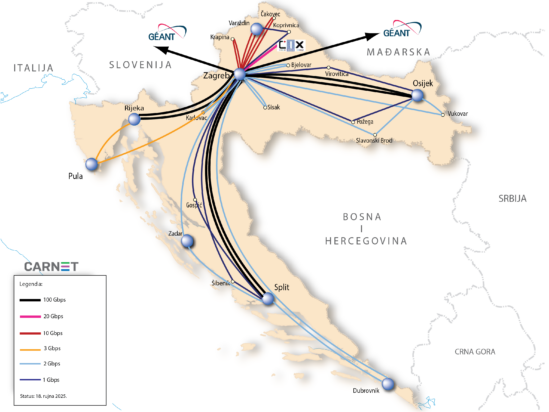 CARNET's network is a private network for the Croatian academic and scientific research community and institutions within the primary and secondary education system. CARNET's institution owns part of the network infrastructure, and leases most of the lines from a number of telecommunications service providers.
The CARNET network is an example of a WAN (Wide Area Network) that connects CARNET members throughout Croatia into a compact information and communication entity. The CARNET network is a data network intended for data transmission using the TCP/IP (Transport Control Protocol / Internet Protocol) protocol. Currently supported versions of the TCP/IP protocol within the CARNET network as an integral part of it are versions 4 and 6 (IPv4 and IPv6). CARNET provides its members with virtual private network services.
The key characteristic of any private network is its connection to the global network – the internet. The CARNET network has achieved this connection through the pan-European research network GÉANT, with a current connection speed of 100 Gb/s. The GÉANT network is the result of an initiative by the European Community and the association of European academic networks to establish a technologically advanced computer network that connects all European academic and research national networks and also provides a connection to the so-called commercial internet. The connection to other internet service providers in Croatia is established through the Croatian Internet eXchange (CIX) point of exchange for internet traffic.
Within Croatia, the CARNET network connects larger and smaller Croatian cities on the mainland, as well as several locations on islands. Larger university centers (Dubrovnik, Osijek, Pula, Rijeka, Slavonski Brod, Split, Varaždin, Zadar, Zagreb) are connected with links ranging from 2 Gb/s to 100 Gb/s, while smaller centers are provided with links at speeds from 1 Gb/s to 10 Gb/s. The infrastructure is particularly advanced in Zagreb, Split, Rijeka, and Osijek, where faculties and research institutions are connected at speeds up to 10 Gb/s. Institutions from the primary and secondary education system are also connected to the CARNET network with access speeds from 4 Mb/s to 10 Gb/s. In Rijeka, Zagreb, Split, and Pula, CARNET uses its own constructed infrastructure to connect the locations of institutions to the CARNET network.
CARNET connects their locations to the CARNET network based on agreements with the Ministry of Health, the Ministry of Labour, Pension System, Family and Social Policy, and the Ministry of Economy and Sustainable Development, but not all services available to primary users from the Ministry of Science and Education are available to users.